An AI department, built into your business
Fixed price after a conversation. You approve, the system does the work.
An AI department is not a chatbot and not a tool you operate. It is a process that runs on its own and waits for you at one point: approval.
The entry is a conversation: we look at one task, then I name the fixed price for the installation.
Customer service, as an example
A customer request comes in.
The system sorts it: needs a reply, needs a decision, deadline or money involved, or just for your information.
For requests that need a reply, a finished draft is waiting: in the customer's language, in your tone.
You read, edit if needed, send. At first, nothing goes out without your click.
Fifteen minutes every week: look at the numbers, flag the worst reply of the week. The system learns from that.
Autonomy is earned: once your approvals go through unchanged for weeks, the department may handle low-risk work on its own. Everything is logged; anything sensitive stays with you.
What it looks like
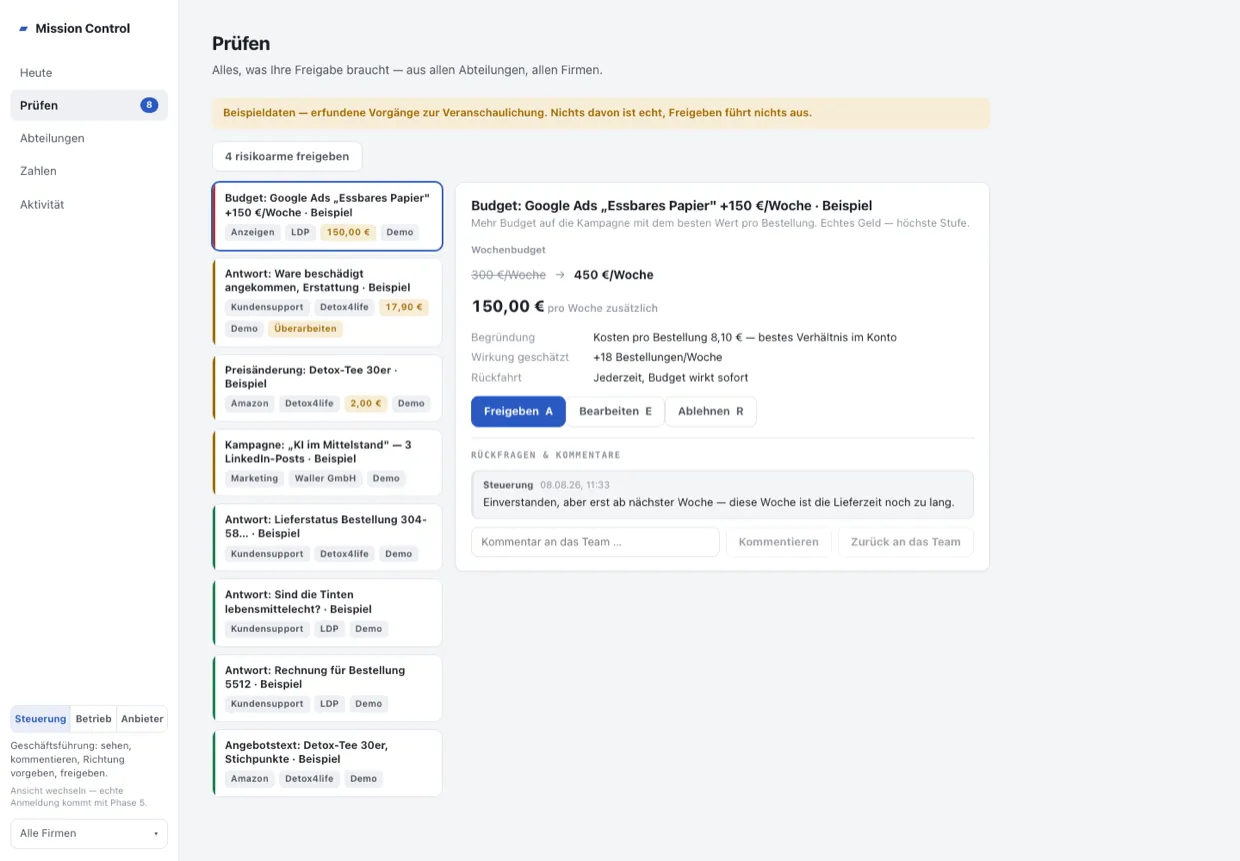
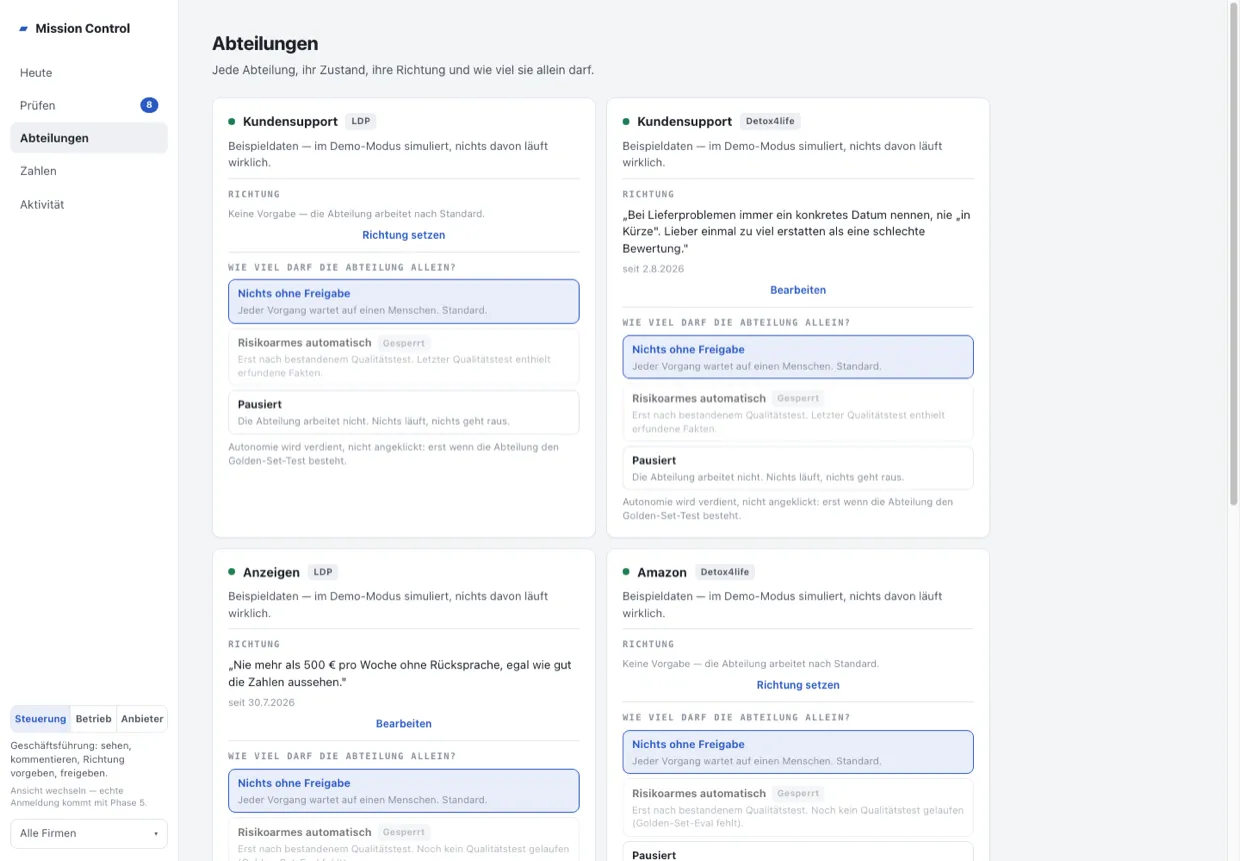
You steer this through Mission Control: one list of everything waiting for your approval, across all departments. The images show sample data from demo mode.
The departments
Each department has one responsibility, its own workflows and its own quality check. All of them deliver into the same approval list:
Customer support
Reads the inbox and drafts replies in your tone. In the approval list: ready-to-send draft replies.
Marketing
Plans posts and produces drafts: text, image, video. In the approval list: finished posts with a date.
Ads
Monitors campaigns and budgets. In the approval list: budget and bid changes, with reasoning and a way back.
Amazon & marketplaces
Checks offers and prices against competitors. In the approval list: price and copy changes.
SEO
Reviews Google and Bing every week and checks who AI assistants name in buying answers. In the approval list: concrete change proposals.
Dedicated pages per department are coming. More departments follow once they have proven themselves in my own companies.
What you get
- Approval principle
- At first, nothing reaches a customer without your click. Built in, not a setting.
- Earned autonomy
- Every department has levels: nothing without approval, low-risk automatic, paused. It moves up a level only once quality is proven over weeks. You can step it back down anytime.
- Quality check
- Before going live, I test on real past cases from your business whether the drafts are ready to send and whether nothing was made up. You get the result as a report.
- Numbers
- Requests handled, escalations, time saved. Monthly, on one page, in plain language.
- Playbook
- At handover you get a playbook: how to keep the department current yourself, what to check weekly, and how to tell something is stuck.
- Your data
- The system runs on your machine, with your access. AI processing goes through EU endpoints under a data processing agreement, and your data is never used for AI training. Fully local on request: then no email leaves your business.
The goal: a department that works on its own
On day one, nothing goes out without your click. That is not distrust of the technology; it is how trust is built: you see every proposal, and every approval without an edit is evidence.
Once a department runs flawlessly for weeks, we unlock it level by level: low-risk work first, more later. The goal is a department that largely works on its own while you only see the exceptions. How fast that happens is decided by quality, not by the calendar.
Keeping it current: yourself, or as Managed Operations
After installation the department is yours, and the playbook lets you keep it current yourself. If you'd rather hand that off, book Managed Operations:
- monitoring that the department runs, and telling you when it doesn't
- upkeep across model changes: before any change, your real cases are re-checked so quality doesn't slip
- the monthly report with your numbers
- the weekly improvement pass
- a human you can call
Fixed monthly price per department, cancel monthly. I name the price together with the installation quote.
How I know this
I build these systems for my own companies first. My entire email operation runs through such a department: 22 mailboxes, every day. The visibility check for my own shops runs automatically every week.
What doesn't work for me, I don't sell.
Frequently asked questions
What is an AI department?
A built-in process that takes over one task in your business: sorting requests, drafting replies, measuring numbers. It runs on its own and waits for you at one point: approval. Not a chatbot, not a subscription tool, but a system inside your business.
Can the AI send emails to customers on its own?
Not at first: every draft waits for your click. Only once your approvals go through unchanged for weeks may the department handle low-risk work on its own, level by level and reversible at any time. Everything is logged.
What does an AI department cost?
The entry is a conversation in which we go through the task. Then I name a fixed price for the installation, before anything is built. Ongoing operations are optional: a playbook to do it yourself, or Managed Operations at a fixed monthly price.
What happens to my data?
The system runs on your machine, with your access. AI processing goes through EU endpoints under a data processing agreement, and your data is never used for AI training. Fully local on request.
Which department first?
The one whose work costs you the most time. For most businesses, that is the inbox. That is exactly what the conversation settles, before anything is built.
Request a call
Write two or three sentences about your business and the task that eats time. You will get a reply within one business day.
Prefer to talk first? Free intro call